

“We join spokes together in a wheel, but it is the center hole that makes the wagon move.” – Lao Tzu, Tao Te Ching
Empty and Full has been teaching me for decades and holds deep personal meaning for me on many levels. I started drawing before I could talk. I earned a BFA in painting and literature. I illustrated children’s books and comics professionally. I still sketch compositions and storyboards, both in the field and in my studio. Making something by hand over an extended period differs from making it quickly with a machine, shifting both the possibilities and qualities of perception. But where, exactly, does the difference lie? How does—how is it even possible that—the artist enters and remains in the work, whether working with a stick or a machine? I recompose many of my photographs, arranging elements like collage, and sometimes create new ones by painting them digitally. I color grade and sequence images in series like a cinematographer. Whether essay or poetry, I write complementary texts to accompany them, and increasingly those words are making their way into the images themselves. Cheng gives me ways to think about what passes between the artist, the medium, the work, the world, and the viewer —and what remains alive between them.
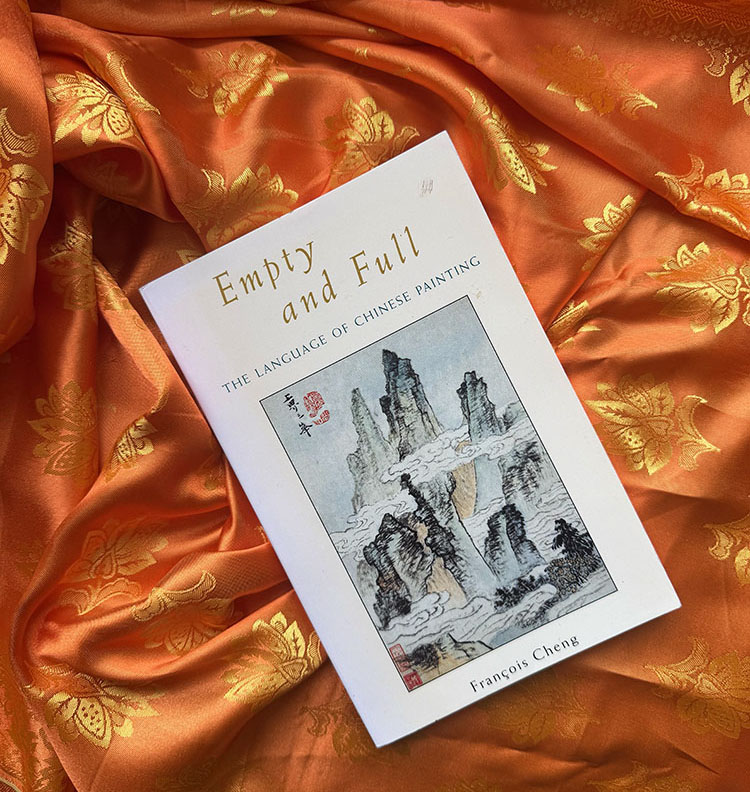
François Cheng’s Empty and Full: The Language of Chinese Painting is one of the finest introductions to classical Chinese aesthetics available in English. Originally written in French by the Chinese-born poet, translator, and calligrapher, the book’s subject is painting, but its deeper message is how we perceive reality and participate in it. It’s less a history of Chinese art and more a philosophy of seeing.
Here are some of its central ideas.
Representation > Relationship
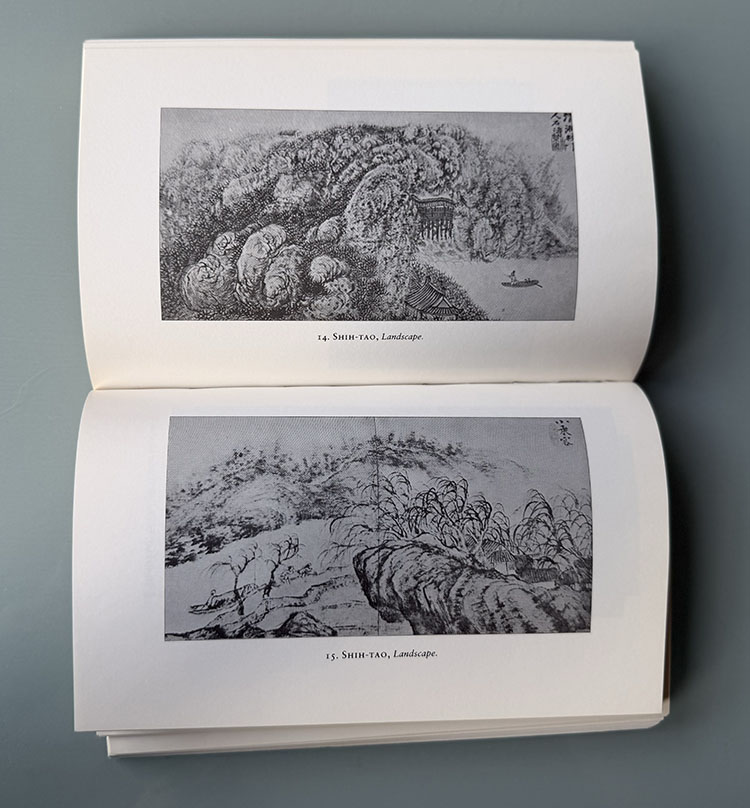
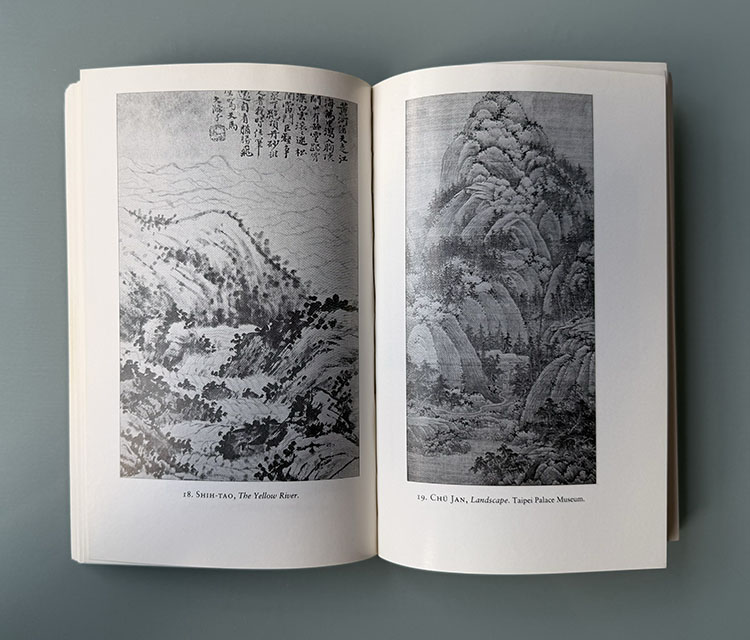
Western painting has often emphasized representation or how objects occupy space. Classical Chinese painting is more concerned with relationship or how things arise through dynamic interactions. Rather than depicting isolated objects, the painter reveals the circulation of life (qi) through mountains, water, clouds, trees, and empty space. The painting becomes a living event rather than a static picture.
Empty and Full
Complementary forces structure every painting.
Full
- mountains
- trees
- rocks
- figures
- ink
- brush marks
Empty
- mist
- sky
- water
- unpainted paper
- intervals
- breathing room
- silence
One of Cheng’s recurring points is that fullness becomes expressive only because emptiness surrounds and penetrates it. Emptiness is not absence. It’s potential. Like silence in music, it enables everything else to exist. Emptiness makes fullness and transformation possible.
Empty Space Is Active
One of the book’s most important lessons is that blank paper is never blank.
First, it represents many things including weather, air, light, distance, and movement.
Second, the viewer mentally completes what is not shown, making seeing participatory.
This idea anticipates many contemporary ideas about viewer participation, although Cheng grounds it in Daoist and Chan (Zen) traditions rather than modern psychology.
Yin and Yang
The entire visual language follows complementary opposites:
- mountain / water
- solid / fluid
- stillness / movement
- dark / light
- near / far
- visible / invisible
- full / empty
These are never enemies; each gives birth to the other.
Qi (Life Energy)
Perhaps the book’s most important concept is qi. More than copying appearance, painting reveals vitality, breath, movement, rhythm, and transformation. A successful painting feels alive because its internal energies flow naturally.
An extension of breathing, brushwork records this movement. Breathing is both literal and metaphorical. The painter breathes through the brush. The composition breathes through spacing. The viewer breathes through the rhythm of looking.
Recording movement, timing, speed, and pressure, brushstrokes reveal the state of mind that produced them. Technique becomes inseparable from character.
Nature is process
Water is never merely water. Ocean becomes cloud. Cloud becomes rain. Rain becomes river. River becomes sea. Sea becomes cloud. Nothing exists independently. Everything belongs to a larger cycle, participating in continual transformation. `
Time rather than frozen moments
Unlike Renaissance perspective, Chinese painting often unfolds over time. Rolled out and up, scrolls are experienced gradually. Valleys disappear as mountains emerge only to disappear into clouds. Then the unwound scroll is rewound, reversing the viewer’s journey through the landscape. Looking resembles walking.
Multiple perspectives
Instead of one fixed viewpoint, Chinese painting combines many. The eye moves: across fields and rivers, through forests, down into valleys, upward onto peaks. Perspective becomes experiential rather than optical, representing lived movement through space.
The role of the viewer
The painting remains incomplete until someone enters it. The viewer mentally follows paths, crosses rivers, climbs mountains, inhabits empty spaces. Seeing is creative. The viewer finishes the work.
Three philosophical foundations
Cheng shows how Chinese painting synthesizes three traditions.
Confucianism
- discipline
- cultivation
- ethical refinement
- tradition
Taoism
- spontaneity
- natural process
- emptiness as generative
- harmony with change
Chan Buddhism
- immediacy
- silence
- direct experience
- non-duality
Rather than competing, these traditions interpenetrate.
Rhythm
Composition depends on rhythm more than geometry. Repeating forms create visual breath. Alternations of dense/open, dark/light, near/far, still/moving generate movement through the image, paralleling musical composition.
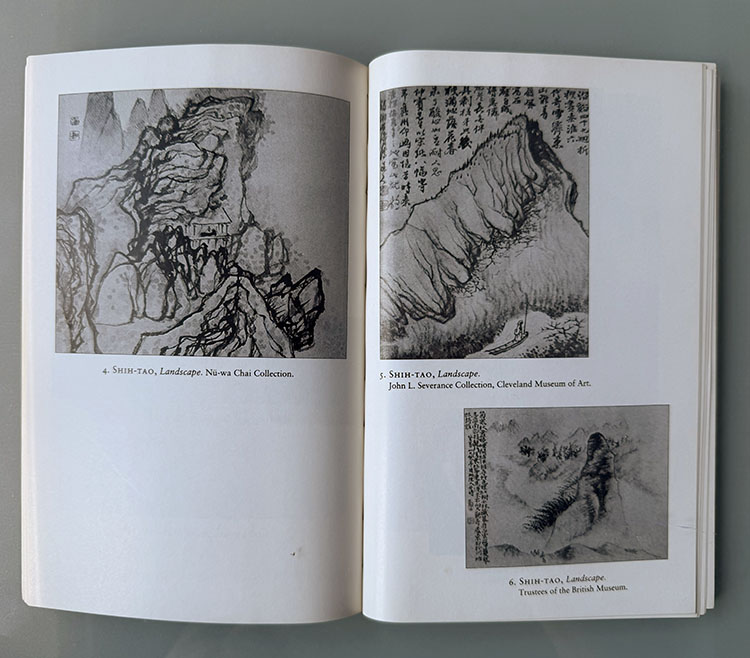
What Cheng means by “language”
The subtitle, The Language of Chinese Painting, is carefully chosen. Just as Chinese writing, characters are drawn from forms in nature, painting has: vocabulary, grammar, syntax, punctuation, and rhythm. Brushstrokes become words. Compositions become sentences. Scrolls become poems.
A few memorable ideas
Several ideas recur throughout the book:
- Emptiness is not nothingness but possibility.
- Paintings contain breathing spaces.
- Nature is relationship, not object.
- Brushwork records the painter’s inner life.
- The invisible is as important as the visible.
- The viewer completes the work.
- Painting reveals becoming rather than being.
Empty and Full is not simply a book about Chinese painting. It is a meditation on how art can become less an image to consume than a relationship to enter. Through his writing, Cheng enters the conversation between the painters, each other, and nature.
Here are some of my favorite excerpts …
3 Beauties – pg 2
“Chinese aesthetic thought always envisions the beautiful in its relationship with the true. In judging a work of art, the tradition distinguishes three degrees of excellence: the neng-p’in (work of accomplished talent), the miao-p’in (work of marvelous essence), and the shen-p’in (work of divine spirit, which is the highest degree? In defining neng-p’in and miao-p’in, consideration is given to numerous qualifications sometimes connected with the notion of beauty, but the term shen-p’in is applied only to a work of art whose ineffable quality seems to link it to the original universe. A Chinese artist aspires to the ideal of realiziga living microcosm in which it is possible for the macrocosm to function.”
Breath Requires Emptiness – pg 62
“The breaths would not circulate and yin-yang would not operate without emptiness.”
Tao – pg 45
“No-Beginning says: “The Tao cannot be heard; that which is heard is not it. The Tao cannot be seen; that which is seen is not it. The Tao cannot be formulated; that which is formulated is not it. That which gives birth to forms is without form. The Tao should not be named.” And he added: “Whoever answers someone who questions him about the Tao does not know the Tao. The very fact of asking questions about the Tao shows that one has not yet even heard the Tao spoken about. The truth is that the Tao abides neither questions nor answers to questions. To ask questions about the Tao, which does not admit questions, is to consider it as a finite thing. To give answers about the Tao, which does not contain any answers, it is to consider it as a thing devoid of innerness. Whoever gives answers about that which does not have innerness and asks questions about that which is finite does not grasp either the outer universe or its inner origin. He does not cross Mount K’un-lun; he does not go as far as supreme emptiness.” – Chuang-Tzu Intelligence Journeys in the North”]
Possessing Emptiness – pg 53
Quoting – Lao-Tzu
“Through emptiness, man’s heart can become the model or mirror for itself and the world, because in possessing emptiness and being identified with original emptiness, man finds himself at the source of images and forms. He grasps the rhythm of space and time, and he masters the laws of transformation.”
Emptiness operates at every scale – pg 62
“Emptiness comes into play at every level, from the basic strokes to the composition of the whole.”
5 Levels – pg 64
“Five levels can be distinguished, and we will examine them successively. With the exception of the last, each level is characterized by a binary term that is part of the theory of painting: (1) brush-ink, (2) yin-yang, (3) mountain-water, (4) man-heaven, and (5) the fifth dimension. These levels are not discrete; they form an organic whole. Within this whole, emptiness follows a spiral movement, starting from a center and circling from level to level, as though to untie a knot. This organic conception of a painting reminds us once again of the human body (see chapters 1 and
2) in which the heart, with the median emptiness dwelling within it, concentrates the breaths and then sends them off again to the organs and viscera. This comparison with the human body also reminds us that painting, rather than being a purely aesthetic exercise, is a discipline that engages the whole of a human being, the physical being as well as the spiritual being, the conscious part as well as the unconscious part.”
Calligraphy / Previsualization – pg 67
“Calligraphy exercised a profound influence on the discipline of painting. As early as the Tang period, particularly beginning with Wu Tao-tzu, paintings were executed in a spontaneous fashion without any retouching. Artists maintained a steady rhythm of their gestures, which they tried not to break. Such a conception of the execution of a • picture presupposed that the painter was in advance in possession of a vision of the whole and of the concrete details of what he was going to paint.”
Visible-Invisible – pg 77
Quoting – Pu Yen-T’u
“All things under heaven have their visible-invisible. The visible is the thing’s exterior aspect, its yang; the invisible is its interior image, its yin. A yin, a yang-that is the Tao. It is like a dragon coiling in midheaven. If it shows its naked entirety, without aura and without extension, with what mystery can it be enveloped? That is why a dragon always takes cover behind the clouds. Transporting the winds and rains, it soars amid the lightning bolts, wheeling and spinning-superb! Now he causes his scales to glitter; now he gives a hint of his tail. The spectator, eyes gaping, can never encompass him with a glance. It is through its double aspect of visible-invisible that the dragon exercises its infinite power of fascination. …
The landscape that fascinates a painter must therefore include both the visible and the invisible. All the elements of nature that appear finite are in reality linked with the infinite. In order to integrate the infinite into the finite, to combine the visible and the invisible, painters must know how to take full advantage of the play of fullness-emptiness of which the brush is capable and of the play of concentratedness-dilutedness of which the ink is capable. They can begin with emptiness and make it verge on fullness, or the reverse. The brush must be mobile and vigorous-above all, banality must be avoided. The ink must be nuanced and varied-keep from falling into the obvious. Do not forget that the charm of a thousand mountains and a thousand valleys lies in their hidden curves and secret joinings. There, where the hills embrace one another, where the rocks open to each other, where the trees intermingle, the houses huddle, the road loses itself in the distance, the bridge is mirrored in the water, one must make use of whites in such a way that the halo of the mists and the reflections of the clouds compose an atmosphere charged with grandeur and mystery. Presence without form but endowed with an unwavering inner structure -the whole art of the visible-invisible is not more than what is needed to re-create it!”
Seasons as Reflections of Soul – pg 80
“In paying so much attention to the nuances of a landscape going through the changing seasons, the painter is in reality expressing the states of his own soul.”
Six Inks – pg 80
“Six different types of ink are distinguished and are considered independent colors: dry, diluted, white, wet, concentrated, and black. These are divided into two parallel groups forming three contrasting pairs: dry-wet, diluted-concentrated, and white-black.”
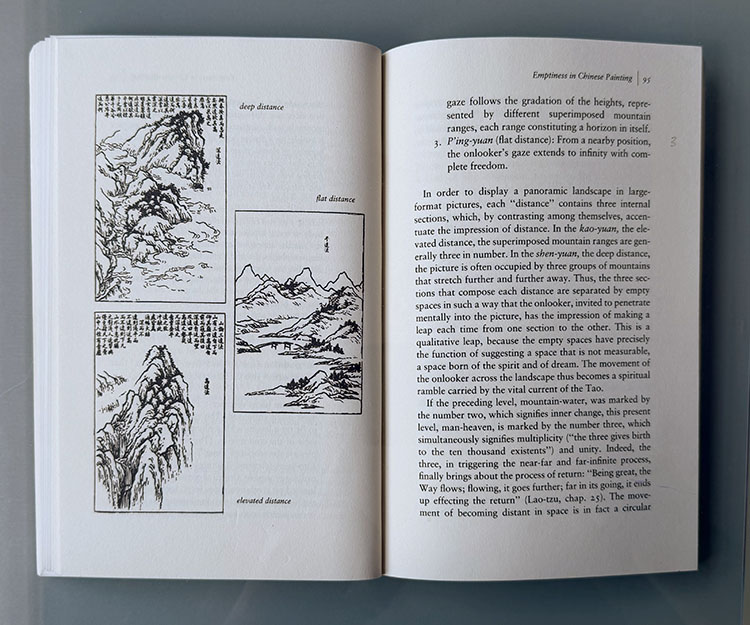
3 Distances – pg 93
I. Shen-yuan (deep distance): This is by far the one most often employed. The spectator is supposed to be on a height with a plunging and panoramic view of the countryside. (The most typical examples are the works of Tung Yuan.)
2. Kao-yuan (elevated distance): This perspective is ordinarily used in a vertical picture. The onlooker, located on a relatively low level, looks up toward the heights. The horizon dominating the picture is consequently not very elevated. The onlooker’s gaze follows the gradation of the heights, represented by different superimposed mountain ranges, each range constituting a horizon in itself.
3. P’ing-yuan (flat distance): From a nearby position, the onlooker’s gaze extends to infinity with complete freedom.
Poem in Picture – pg 96
“The poem inscribed in the blank space of a picture (heaven) is not just an artificially added commentary. It truly inhabits the space (there is no hiatus between the calligraphic signs and G the painted elements; both are done with the same brush) by introducing into it the living dimension of time. Within a painting characterized by three-dimensional space, the poem, through its rhythm and its content (which relates a lived experience), reveals the process by which the painter’s thought process arrived at the picture. By the echo that it arouses, the poem extends the picture further. This is time with its lived rhythm, which is always renewed, time which maintains the openness of space. The inscribed poem permits man, even if he is not represented as a figure in the painting, to mark his presence within heaven-earth.
Thanks to the poem, the play of fullness-emptiness can reveal its profound significance, which is to foster totality 2, beyond contradictions and transformations.”
Blank Paper to Finished – pg 97
“Emptiness, constitutes the basis of the pictorial universe, yet it also transcends this universe and carries it toward the original unity. This unity of emptiness, as ungraspable as it may seem, is what we shall nevertheless be trying to apprehend in its materiality. The paper, which is the support of the picture, and the gesture of the onlooker, who unrolls the scroll on which the picture is painted, are particularly important in this regard.
Conceive of the pure, unmarked paper as the original emptiness with which everything begins, of the first stroke as the act of separating heaven and earth, the strokes that follow and gradually give birth to all forms as the multiple metamorphoses of the first stroke, and finally, of the complete execution of the painting as the supreme degree of development by which things return to the original emptiness. This vision, during periods of high culture, governed the outlook of all Chinese artists. It is what transforms the act of painting into the act of imitating not the spectacles of creation but the very gestures of the creator.”
Unrolling Scrolls Participatory – pg 98
“Rolled up, the painting becomes a universe closed upon itself. To unroll it, each time, is to create for the participating onlooker the miracle of unraveling time, of reliving its lived and mastered rhythm. (Let us remember that in China unrolling and contemplating a masterpiece for a period of hours was an almost sacred ritual.) As the picture is unrolled, this lived time becomes spatialized, not in an abstract framework, but in a qualitative space that is all its own, that cannot be reduced to any other. What the Chinese artist strove for, above all, was to translate lived time into a living space moved by the breaths in which true life unfolded. Once again, this transformation of time-space can only take place because of emptiness. Emptiness introduces internal discontinuity into the linear and temporal development of the picture. By inverting the relationships of inside-outside, far-near, and manifest-potential, it inaugurates the reversible process of the return, which signifies reassuming responsibility for all the life recollected or dreamed that continually keeps emerging.
The ultimate vision of this art would be more musical than pictorial.”
The 5th Dimension – pg 109
“Level 5 is the void that transcends space-time, the supreme state toward which every painting that is inspired by the truth reaches. For this ultimate level, very few descriptive terms are adequate. It is perhaps fitting to cite two expressions used by the Chinese artist to gauge the value of a work and to indicate the ultimate aim of art beyond all notions of beauty: i-ching ste (density of soul) and shen – yun 神韻(divine resonance).@
Brushstroke – pg 122
The brushstroke is not mere line or a mere delineation of the outline of things. Developed in the art of calligraphy, it has many implications. Through its thickness and fineness and the emptiness that it delimits, it represents form and volume. Through its attack and thrust, it expresses 2 rhythm and movement. Through the play of ink, it suggests shadow and light. Finally, by the fact that it is executed instantaneously and without retouching, it introduces the vital breaths. The stroke seeks to capture more than external resemblance. It seeks to capture li, the inner lines of things. At the same time, it relates to and takes on the irresistible instincts of man. Transcending the conflict between drawn line and color, between representations of volume and of movement, by its very simplicity, the stroke incarnate, both the many, and the one and also the law of transformation.”
“One should not fear the incomplete.” – Chang Yanyuan
Sorry, the comment form is closed at this time.