

Writing as a Way of Seeing
.
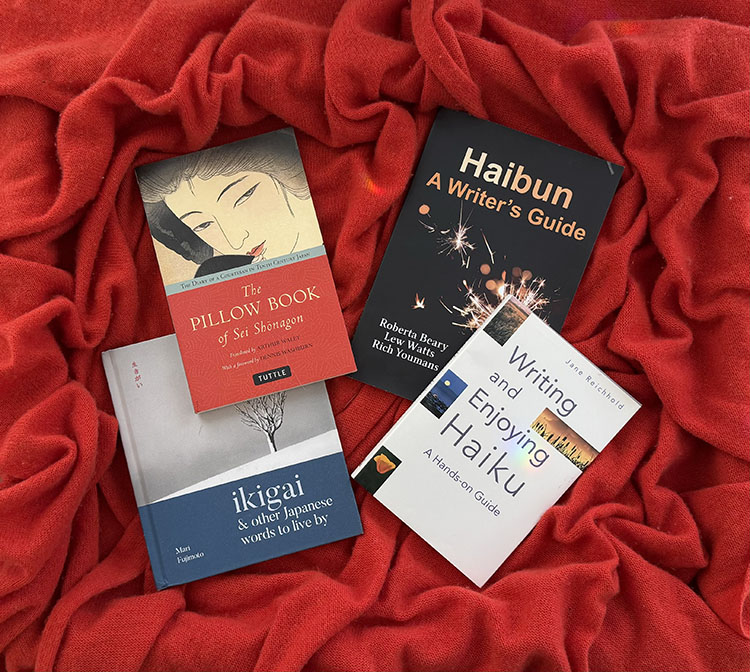
Writing changes the way I see. It slows me down, sharpens my attention, and encourages me to notice what I might otherwise overlook. Sometimes it reveals unexpected connections; sometimes it helps me discover experiences I didn’t know how to name. As a visual artist, I’ve found that writing doesn’t merely describe what I see; it changes how I see and what I make. Four Japanese books, exploring four different forms of writing, have become companions in that exploration. Similar to changing a camera’s lenses, each offers a different way of attending to experience, inviting practices that are simple to begin yet endlessly rich in possibility. I’m drawn to them for what they say, what they encourage me to do – and how those practices continue to transform my relationship with the world.
.
Each form offers different ideas about and relationships with completion and lack of completion, clarified by their use of space. Haiku, a fragment and a phrase without punctuation presented in three broken lines surrounded by blank space, resists completion, leaving that possibility open for the reader. Haibun uses space on the page to break open the continuity of prose with poetry. Zuihitusu leaps from fragment to fragment, often connecting passages from the past or yet to come with the present, creating an invisible network of links between pages. Haiga uses open space within a frame that text may or may not occupy.
.
.
.
1. Haiku — The Art of Noticing
.
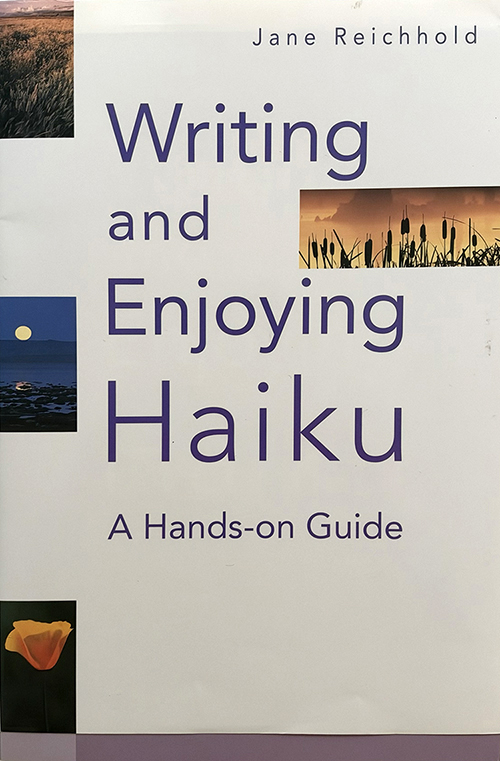
Jane Reichhold — Writing and Enjoying Haiku: A Hands-on Guide
.
Personal Reflection
Writing haiku changes the way I see. It encourages me to pay attention and be more receptive to moments I might overlook. Like photography, haiku invites me to discover how extraordinary the ordinary can be. Unlike a photograph, which can preserve a single moment in extraordinary detail, haiku distills an experience, instantaneous or extended, into a few carefully chosen words, leaving space for the reader’s imagination. It epitomizes the writer’s maxim: show, don’t tell. Using simple language to create images, through direct observation with minimal interpretation, it encourages readers to reencounter and complete the content it presents – and when shared, it sparks dialogues that encourage participants to witness both each other’s and their own experiences with greater clarity. Both practices remind me that perception is selective, that a small shift in attention can transform an experience, and that what we leave out can be as important as what we include.
.
About the Book
Jane Reichhold’s Writing and Enjoying Haiku is the most accessible and practical introduction to the art of haiku. With one eye open to historical and another to contemporary practices, it explores techniques and possibilities. Reichhold demonstrates that haiku transcends a seventeen-syllable exercise. Through examples and exercises, she encourages readers to cultivate observation, discover unexpected relationships, and express experiences with clarity and economy. Her approach makes haiku approachable for beginners while offering experienced writers insights to deepen their practice.
“Some people come to haiku as a way of capturing the present moment. Just as there are occasions and moments when we wish to take a photograph, there are events and situations that we wish to conserve, contain, and retain.
With only our minds and what we have learned, we are able to preserve that thought, or idea or inspiration, with such validity and perfection that any rereading of a haiku will instantly return us to a particular place or situation. Haiku act as doors to our past. Years after you have written a haiku, you can read it and mentally return …” – Jane Reichhold
Read my article on haiku as a mindfulness practice here.
x …
Here’s one of my haiku, first published in Mariposa.
scirocco
an idea
turns into others
Discover more of my haiku here.
.
.
.
.
2. Haibun — The Art of Connecting
.
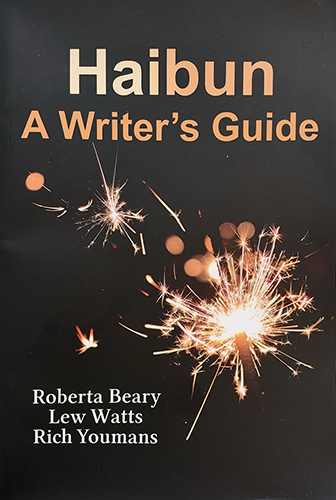
Roberta Beary, Lew Watts, and Rich Youmans — Haibun: A Writer’s Guide
.
Personal Reflection
Haibun combines prose with haiku, bringing together two forms of writing that reveal different dimensions of experience. What fascinates me most is what happens between them. The prose may describe a journey, recall a memory, or explore a thought, while the haiku introduces another perspective, sometimes unexpected or even contradictory. Neither illustrates the other. They complement one another, whether through comparison and/or contrast. Rather than repeating or explaining one another, they can create a third experience that neither contains alone. Together, they show that language changes how we see. Change the language, change the lens.
.
About the Book
Haibun: A Writer’s Guide offers an engaging exploration of this hybrid literary form, traditionally associated with Japanese travel writing and Matsuo Bashō. Roberta Beary, Lew Watts, and Rich Youmans examine how prose, haiku, and titles can work together to create layered experiences. Through examples, commentary, and exercises, they reveal the form’s remarkable flexibility, from personal reflection and memoir to imaginative and experimental writing. The book encourages writers to explore not only what each element communicates, but also what emerges through their relationships.
.
“Successful haibun share one key attribute: the haiku add to and deepen the meaning of the prose. A haibun may have exquisite prose and an outstanding haiku, but without that partnership between the two, both are simply strangers standing next to each other. To succeed, each needs to bring out something more than either could alone: a + b = c, with c being the “aha” that derives from the combination, like a spark from two live wires.” – Roberta Beary, Lew Watts, and Rich Youmans
.
Here’s one of my haibun, first published in Drifting Sands.
.
Talking With Eliot Porter
.
I’m surprised to find your book Antarctica in the stern, where the library rests, next to Shackleton’s Endurance. It’s time for one more conversation.
.
Remember after your heart surgery when I said, “Your generation is extraordinary to have seen so much change in a single lifetime – two world wars, personal computers, genetic engineering, and men on the moon? You smiled and said, “You’ll see more.”
.
There was the moment when, after discussing the great issues of our times, desertification (They call it climate change now.) and overpopulation (We’ve doubled our numbers since then, and we’ll do it again in my child’s lifetime.), you predicted, “Your generation will be the one that determines whether we pass on a habitable environment for the future – or not.” How are we doing now?
.
generations hope
for the next and another
so we come and go
.
But let’s talk about this place, Antarctica, the bottom of our world. The remotest, highest, driest, windiest desert, with the whitest whites and the bluest blues, its core of silence encircled by rings of aquatic life. Many times, you showed me your photographs, becoming uncharacteristically at a loss for words and even breath. Because you were so articulate, I didn’t understand.
.
Now, as I turn through your pages looking at you no longer looking at me, I find myself in that same state. My words keep flowing uncontrollably in fits interrupted by echoing silences before swelling again in waves of sound, anticipating another loss. You tried but ultimately couldn’t tell me how beautiful this end of the world is. And now I know how that feels. How lucky to be here, however briefly.
.
we all hope for more
life is exquisitely brief
living through others
Discover more of my haibun here.
.
.
.
.
3. Zuihitsu — The Art of Following Thought
.
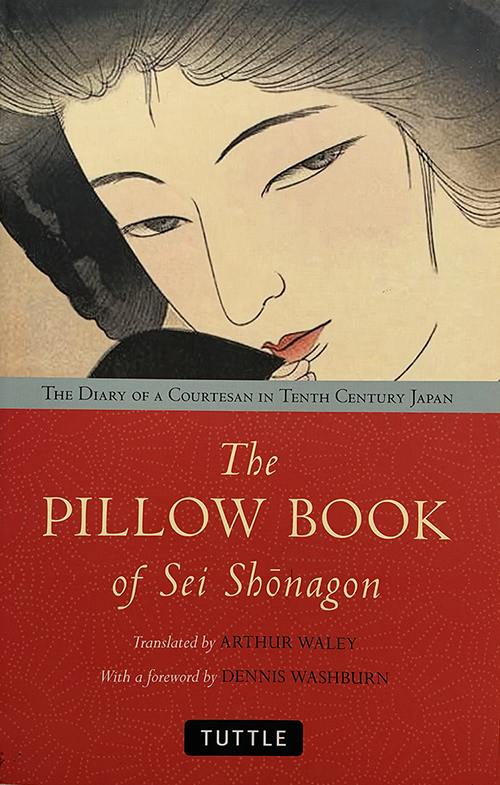
Sei Shōnagon — The Pillow Book
Personal Reflection
Zuihitsu encourages me to follow my thoughts wherever they lead. The flow becomes as or more important than its contents. Collections of fragments – observations, memories, lists, fragments, impressions, and associations – accumulate without the obligation to resolve themselves into a single argument or narrative. This freedom feels particularly valuable while traveling, when unfamiliar surroundings continually interrupt habitual patterns of attention, heightening it. Writing becomes a way to discover connections rather than record conclusions. Its fragmentary nature is often truer to my experience. Sometimes, fragments reveal relationships I hadn’t consciously recognized. What initially seems incidental may become essential. And what begins as a simple observation can lead somewhere entirely unexpected.
.
About the Book
Written around the turn of the eleventh century, Sei Shōnagon’s The Pillow Book is an extraordinary collection of observations, anecdotes, lists, judgments, and reflections from life at the Japanese imperial court. Frequently associated with the origins of zuihitsu, or writing that follows the brush, the book moves freely between intimate observations, lyrical descriptions, sharp social commentary, and playful catalogs. Shōnagon’s distinctive voice reminds me that attentive observation need not always be solemn. It can be opinionated, witty, surprising, and delightfully unpredictable.
.
Read Kimiko Hahn’s zuihitsu on zuihitsu here.
Excerpt from Sei Shonagon’s Pillow Book – translated by Ivan Morris
.
17. Things That Arouse a Fond Memory of the Past Dried hollyhock. The objects used during the Display of Dolls. To find a piece of deep violet or grape-coloured material that has been pressed between the pages of a notebook. It is a rainy day and one is feeling bored. To pass the time, one starts looking through some old papers. And then one comes across the letters of a man one used to love. Last year’s paper fan. A night with a clear moon.
18. A Palm-Leaf Carriage Should Move Slowly
A palm-leaf carriage should move slowly, or else it loses its dignity. A wickerwork carriage, [85] on the other hand, should go fast. Hardly has one seen it pass the gate when it is out of sight, and all that remains is the attendants who run after it. At such moments I enjoy wondering who the passengers may be. But, if a wickerwork carriage moves slowly, one has plenty of time to observe it, and that becomes very dull.
.
Here’s an excerpt of one of my zuihitsu.
.
The Whole Picture
.
after The Guardian’s 1986 Advert Points of View
.
Scene 1
Voice-over An event seen from one point of view gives one impression.
Eye-level, a skinhead races down the street towards me.
At the street corner behind, clocking him, is a sedan driving by.
To my right, his left, a woman in an apron, leans back, watching, arms folded.
Recently committed a crime?
.
Scene 2
Voice-over Seen from another point of view it gives quite a different impression.
Cut to the corner panning, I watch his boots run past her flats,
as he quickly approaches a well-dressed man, hat, coat, turning
to shield himself with a brief case.
About to commit a crime?
.
Scene 3
Voice-over But it’s only when you get the whole picture you can fully understand what’s going on.
Flashback seconds to an aerial view, I see the moments’ movements repeated,
before leather tackles wool suit to the wall,
narrowly escaping a dangling palette’s deluge of debris.
Savior!
It’s black and white
but that doesn’t make a story more true.
So tell me news,
how do I get the whole story
when you offer one?
Wish I could fly,
I want birds’ eyes.
What I really need is a drone
to see the same scene twice at once,
give me pause,
rewind, fast-forward, instant replay
unlimited memory, easy recall.
When my machines run out of batteries,
memory and imagination are my other eyes.
Fueled by other peoples’ stories, I start discovering
how incomplete everything is without everything else.
I’m just one piece in a much larger puzzle
and it’s long past time I start writing my story.
The Rashomon Effect
.
A descriptive term for a recognized psychological phenomenon, rather than a formal, specific psychological theory, the Rashomon Effect describes how a single event may be recounted in different, equally plausible but contradictory ways by people involved, highlighting the unreliability of eyewitnesses. Discrepancies arise from personal experiences, subjective interpretation, biases and prejudices, the fallibility of memory, and underlying motives, influencing how events are first perceived and later recalled before constructing a ‘truth’.
The term draws it’s name from the acclaimed 1950 Japanese film by Akira Kurosawa that tells the story of a samurai’s murder and his wife’s rape, as told by a monk, a bandit, the wife, and the murdered samurai (speaking through a Shinto psychic). Each shares identical elements but interprets them differently. In the end, everyone lies to show their ideal selves.
.
“We see things not as they are, but as we are.
Because it is the ‘I’ behind the ‘eye’ that does the seeing.”
– Anaïs Nin
.
van·ish·ing point
/ˈvaniSHiNG ˌpoint/
noun
1. the point at which receding parallel lines viewed in perspective appear to converge
2. the point at which something that has been growing smaller or faint disappears altogether
.
.
.
.
4. Ikigai — The Art of Naming and Discovering
.
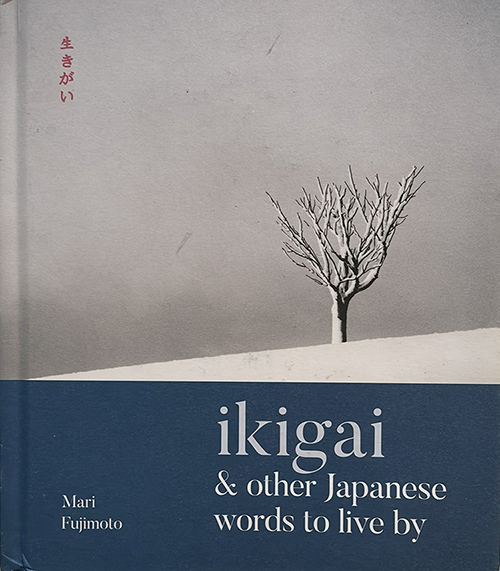
Mari Fujimoto — Ikigai & Other Japanese Words to Live By
.
Personal Reflection
Some Japanese words give names to experiences for which English has no simple equivalent. Shinrin-yoku, or forest bathing, invites me to immerse myself in forest atmospheres, not only for pleasure, but also for health, mental and physical. Learning new words changes what and how I notice, helping me be more open to new experiences and opening new dimensions in what’s familiar. But their greater gift may be the questions they raise. What else am I overlooking because I don’t have a word for it? What remains unnamed, perhaps even unnoticed, in the spaces between concepts? How can discovering language expand my experience, helping me enter into new relationships with the world and myself? Language doesn’t merely describe experience; it can shape perception while reminding me that experience always exceeds language.
.
About the Book
Mari Fujimoto’s Ikigai & Other Japanese Words to Live By introduces Japanese concepts that illuminate relationships with nature, beauty, time, mindfulness, purpose, and everyday life. Accompanied by Michael Kenna’s evocative black-and-white photographs, the book brings language and images into conversation. Their relationship is especially meaningful to me. An image can change how we read a text, just as a text can change how we see an image. Their relationship becomes a creative space of its own. Like haiga, the Japanese tradition of combining poetry and visual art, the pairing of words and photographs invites interactions neither medium produces alone. The book offers more than vocabulary; it encourages me to reconsider familiar experiences and become curious about possibilities I have not yet learned to recognize.
.
Teinei
“Tei means elaborate’ and nei tranquil, but in combination they become something closer to ‘politeness’. This word signals a courteous attitude, where each gesture, even the task of ironing a shirt, is performed with dedication and precision. Where politeness is understood only in the narrow context of manners, tine is a guiding philosophy: rather than acting courteously for the sake of recognition or to show appreciation of others, you behave with the utmost care in order to show excellence in your conduct, paying attention to detail for its own rewards.” – Mari Fujimoto
.
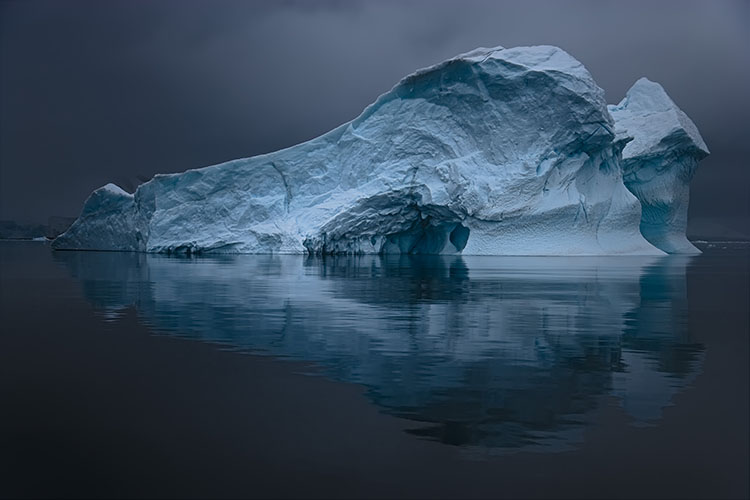
Not strictly haiga, where text appears inside an image’s frame, I often place haiku next to my images.
.
under a waking mind
another sleeping
and then an ocean
Seeing The Way I Write
.
These four books have become companions in my creative life. Each offers a different way to pay attention: noticing the fleeting moment, connecting experiences, following associations, or discovering new dimensions of meaning through language. Their forms are easy to begin practicing, requiring little more than curiosity, a few fleeting moments, and something to write with. More often than not, I use my iPhone; it’s always with me and keeps my past writings in the present. The more I practice, the more the possibilities – the more I – continue to unfold.
.
For me, writing and photography are not separate activities. Each changes the way I approach the other. Sometimes words follow images; sometimes images follow words. Sometimes their interaction leads somewhere neither can take me alone. Both are ways of exploring the world and my experience of it.
–
As I prepare for my fourth journey to Japan, I’ll carry these books—and the practices they’ve inspired—with me. I’ll be looking, listening, photographing, and writing, curious about what I’ll discover and what may change along the way.
.
Follow my journey on Instagram.
Sorry, the comment form is closed at this time.